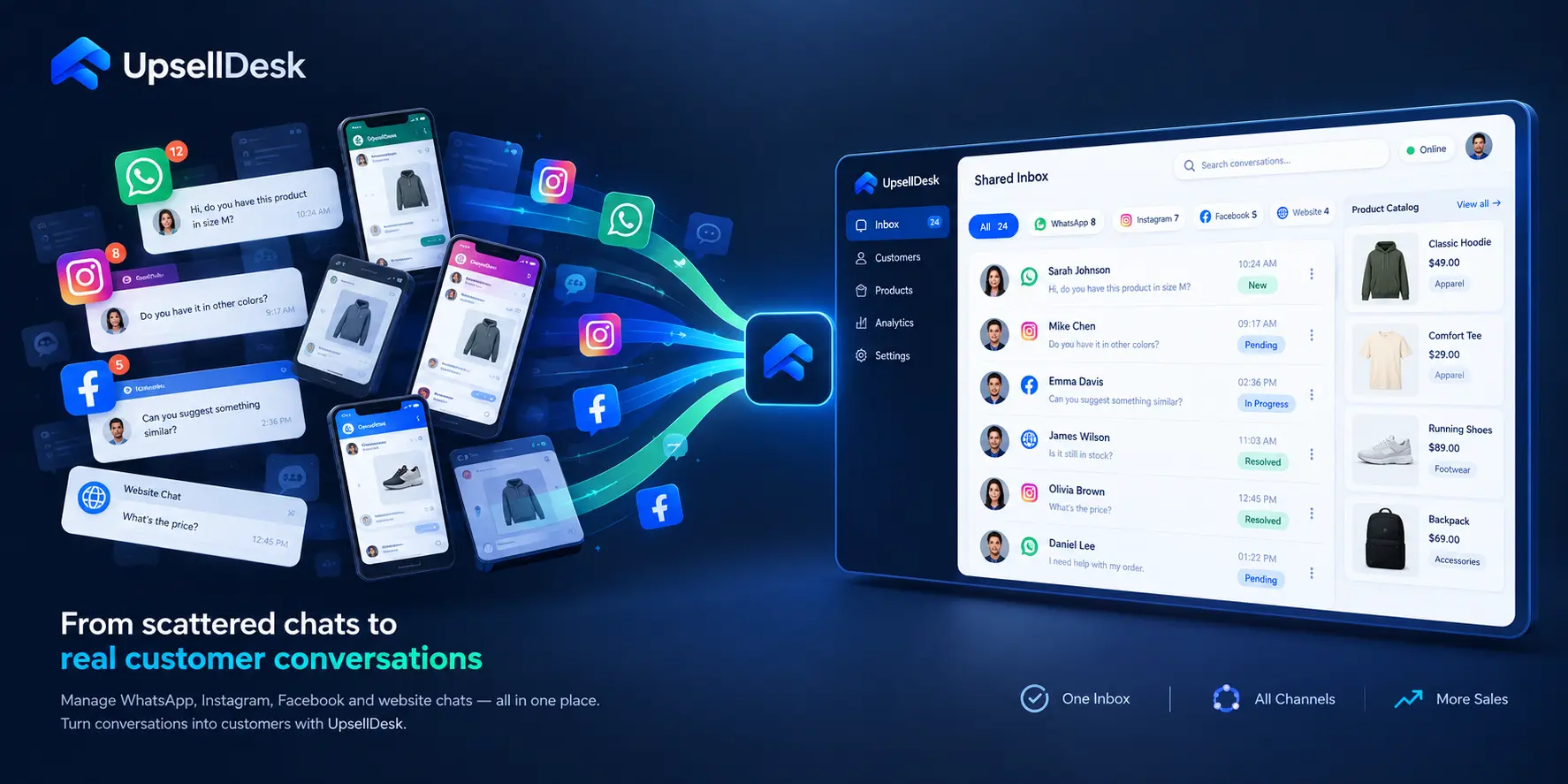
Stop Pre-Order Chargebacks: Automate Backorder Support
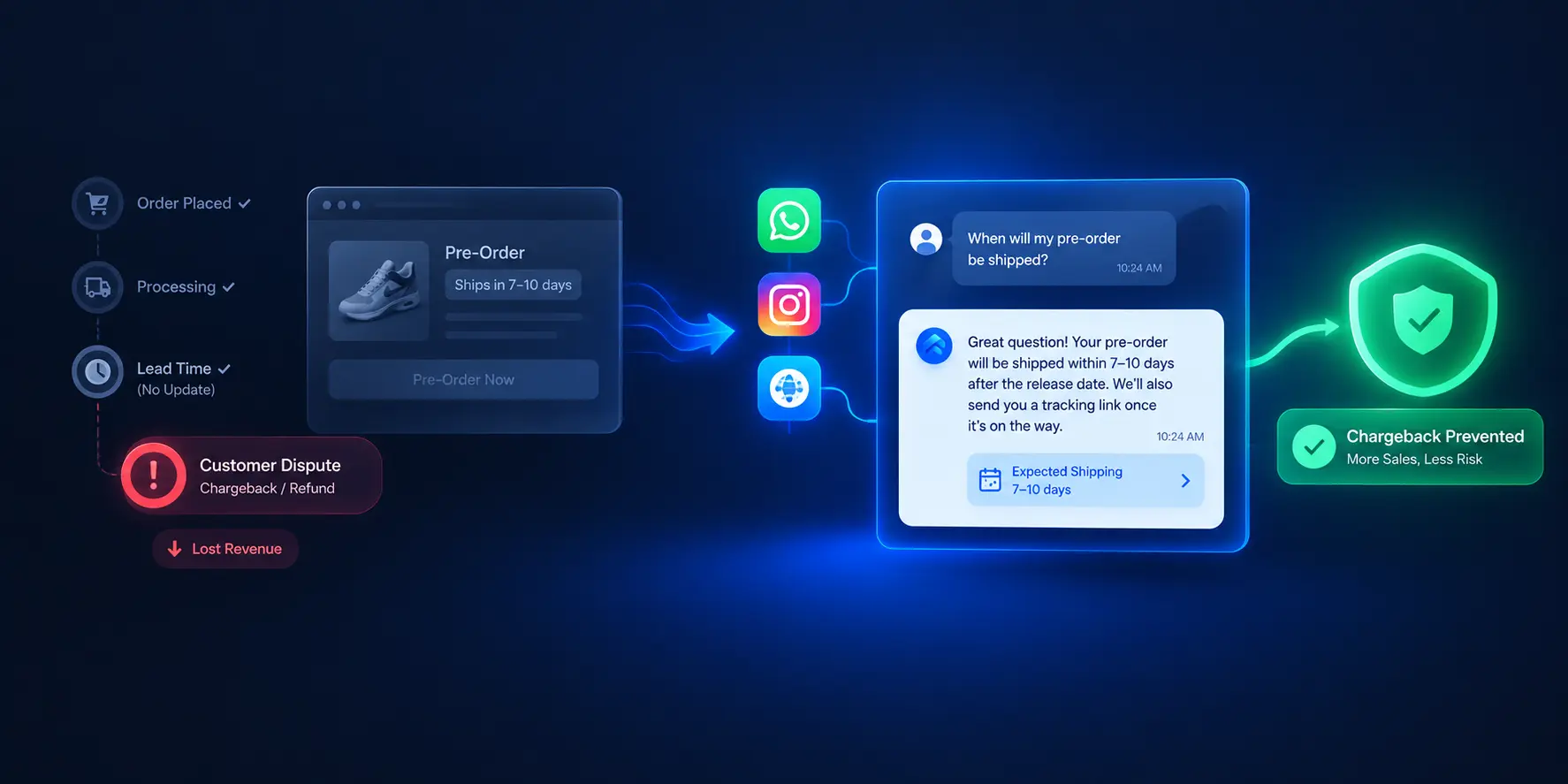
How D2C brands automate pre-order and backorder inquiries across WhatsApp, Instagram, and web chat to prevent chargebacks and cancellations.
Stopping Pre-Order Chargebacks: How D2C Brands Automate Backorder Support and Protect Revenue
For direct-to-consumer (D2C) brands selling via pre-orders, custom production runs, or backordered stock drops, revenue generation happens before inventory hits the warehouse. Whether launching a seasonal fashion collection, funding a specialized gear run, or managing stock replenishment delays, pre-orders allow merchants to validate demand, optimize cash flow, and build anticipation.
However, pre-order business models introduce a critical operational vulnerability: the post-purchase lead-time window.
When a customer pays upfront for a product scheduled to ship weeks or months later, silence creates anxiety. Without continuous, proactive communication across modern messaging channels, buyer excitement quickly turns into fear. When customers receive delayed or generic responses to shipping inquiries, many do not bother requesting a standard order cancellation—they file an "Item Not Received" or fraud chargeback with their credit card issuer.
Every chargeback results in a lost order, a non-refundable dispute fee ($15–$50 per transaction), and payment processor account warnings.
This guide breaks down the psychological mechanics of pre-order chargebacks, identifies why traditional email disclaimers fail, and outlines a practical 4-step framework to automate pre-order and backorder inquiry resolution across website chat, WhatsApp, Instagram DMs, and Facebook Messenger.
The Post-Purchase Anxiety Window: Why Pre-Order Buyers Panic
The Silent Lead-Time Trap: What Happens Between Purchase and Shipping
In standard e-commerce transactions, fulfillment occurs within 24–72 hours. Buyers receive automated tracking numbers and parcel scans within days. In pre-order and backorder models, the timeline between checkout and dispatch stretches across multi-week or multi-month windows.
During this lead time, the buyer's mental state moves through three distinct phases:
- Initial Enthusiasm (Days 1–3): The customer completes checkout, receives an automated confirmation email, and feels satisfied with the purchase.
- The Information Void (Days 4–14): As time passes without visible progress or updates, excitement fades. The transaction slips out of mind until the credit card statement arrives or an ad for a competitor appears.
- Buyer Anxiety & Fraud Suspicion (Days 15+): The customer begins asking: "Was this store a scam?", "Why hasn't this shipped yet?", or "Did they forget my order?"
If the customer reaches out during the third phase and encounters unanswered messages or generic, unhelpful auto-replies, anxiety escalates immediately into financial panic.
The Chargeback Escalation Chain: From Unanswered DM to "Item Not Received" Dispute
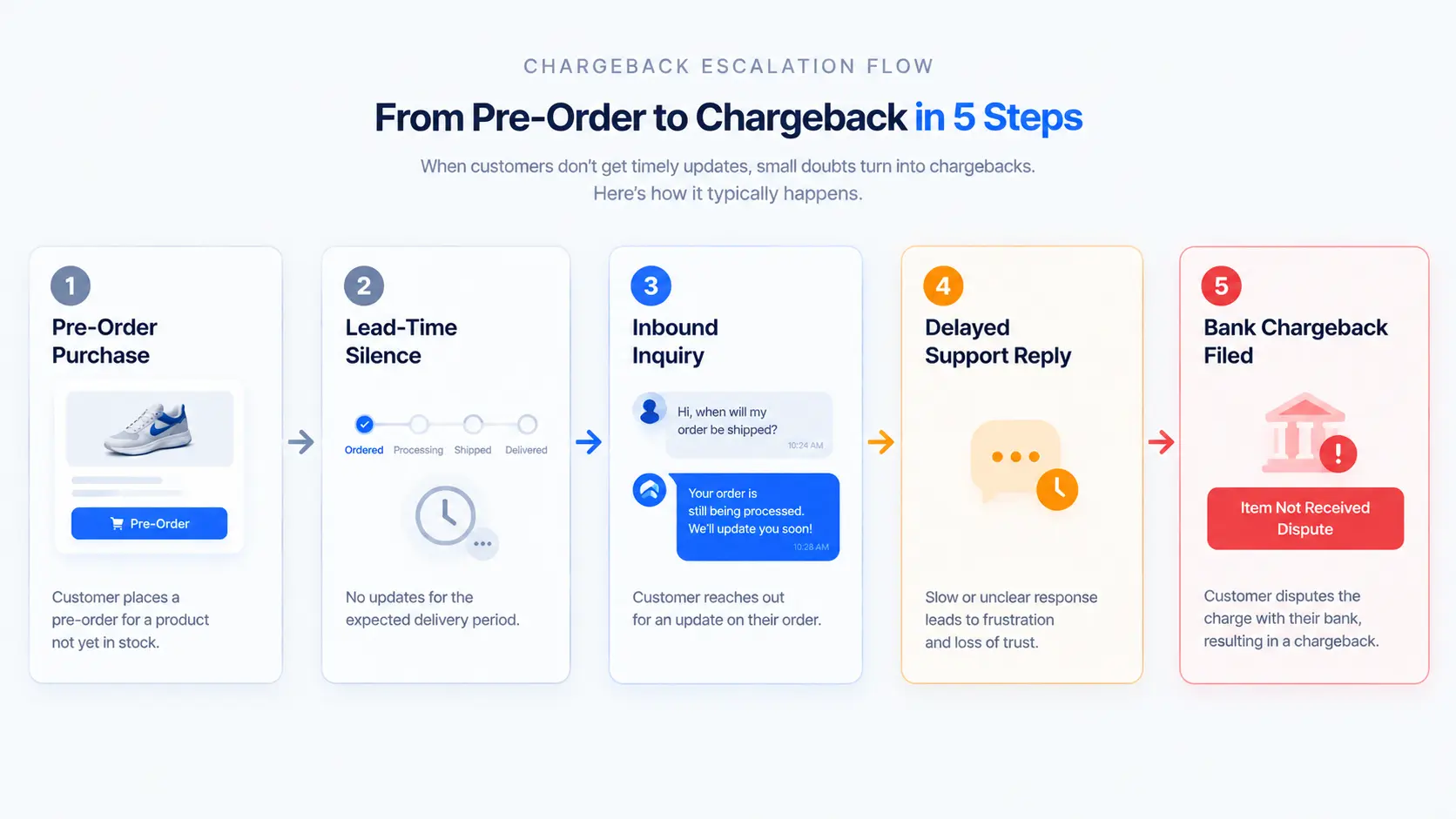
When an anxious pre-order buyer reaches a breaking point, their escalation path follows a predictable pattern:
Pre-Order Purchase → Lead-Time Silence → Inbound DM/Chat Inquiry → Delayed/Generic Support Reply → Bank Chargeback Filed ("Item Not Received")
Merchants across operator communities repeatedly report this pattern. A buyer orders a clearly labeled pre-order item, but after a week without an update, sends a direct message on Instagram or WhatsApp asking when it will ship. If the customer support team takes 48 hours to reply—or sends a canned response that fails to explain the production timeline—the buyer bypasses the store's customer service altogether and contacts their bank to report a fraudulent charge.
The True Cost of Pre-Order Disputes: Lost Margins, Admin Fees, and Processor Flags
Chargebacks inflict far more damage than lost top-line sales revenue:
- Dispute Fees: Payment gateways charge non-refundable dispute fees ranging from $15 to $50 per claim, regardless of whether the merchant wins or loses the dispute.
- Lost Inventory & Administrative Overhead: Staff members waste hours gathering order confirmation receipts, product page terms, and delivery logs to submit chargeback dispute paperwork.
- Payment Processor Sanctions: If a merchant's chargeback ratio exceeds 0.9% to 1.0% of total transactions, payment processors flag the account, hold reserve funds, or terminate processing capabilities entirely.
Why Traditional Pre-Order Communication Fails
Passive Email Updates vs. Messaging Channels (Spam Filters and Low Open Rates)
Historically, merchants relied on broadcast emails to communicate pre-order updates and supplier delays. However, modern inbox algorithms routinely route transactional marketing updates into spam or promotions folders.
When an update email lands in spam, the merchant assumes the customer was notified, while the customer believes they were ignored. When buyers have urgent questions about their orders, they do not check spam folders—they open WhatsApp, Instagram DMs, or live website chat.
Static Store Disclaimers: Why Buyers Miss Page Footers and Confirmation Notes
Placing pre-order disclaimers on product detail pages (PDPs), cart banners, or checkout footers is essential for legal clarity, but it rarely prevents customer panic.
During impulse checkouts, buyers frequently skim text and miss shipping lead times. Once checkout is complete, customers rarely return to the PDP to re-read fine print. When uncertainty strikes weeks later, buyers expect conversational verification, not static website text.
Support Team Overwhelm: Juggling Repetitive WISMO Questions Across Disconnected Apps
Managing pre-order communication manually across fragmented channels creates massive support bottlenecks:
- Support agents spend hours copy-pasting the same production timeline responses across Instagram, WhatsApp, Facebook Messenger, and web chat.
- Context switching between helpdesks, messaging apps, and store backends slows response times.
- Delayed responses during peak inquiry hours leave customers stranded in the information void, increasing chargeback risks.
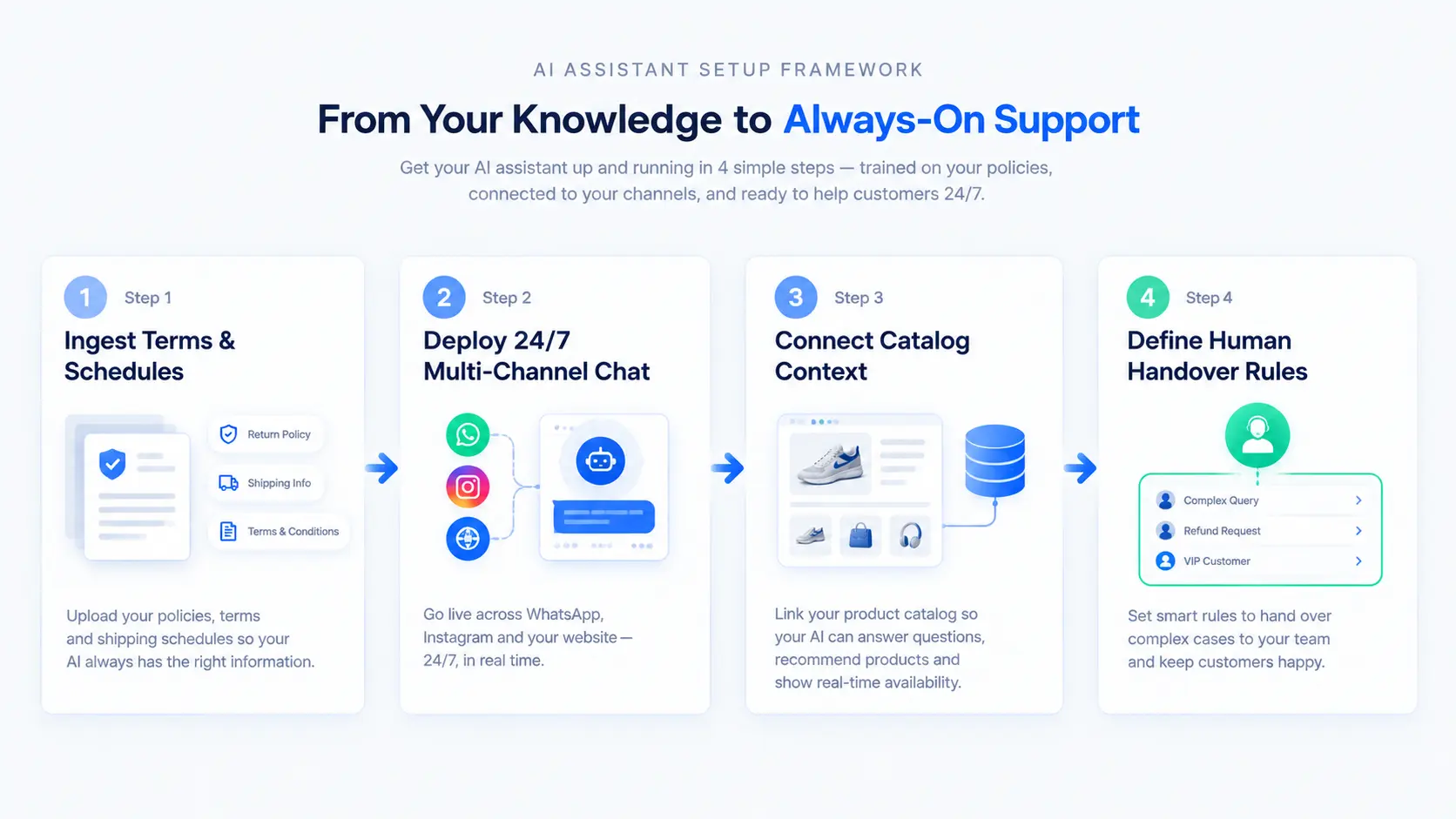
A 4-Step Framework to Automate Pre-Order & Backorder Support
To prevent pre-order cancellations and chargebacks, merchants must replace passive email notifications with 24/7, multi-channel, conversational support.
Step 1: Ingest Terms & Schedules → Step 2: Deploy 24/7 Multi-Channel Chat → Step 3: Connect Catalog Context → Step 4: Define Human Handover Rules
Step 1: Centralize Pre-Order Policies, Batch Timelines, and Terms in an AI Knowledge Base
The foundation of automated pre-order support is feeding structured business knowledge into conversational AI models.
Merchants should upload and train AI assistants on:
- Pre-Order Policies: Deposit terms, cancellation windows, refund conditions, and payment schedules.
- Production Batch Schedules: Estimated manufacturing completion dates, port arrival windows, and dispatch batches.
- FAQ Knowledge Base: Clear answers to common questions such as "Can I change my shipping address before my pre-order ships?" or "How do split shipments work if I bought in-stock items with a pre-order?"
When AI assistants are trained on exact policy documents and timeline notes, they deliver accurate, consistent explanations without requiring manual agent intervention.
Step 2: Deploy 24/7 Automated Response Workflows Across Website Chat, WhatsApp, and Social DMs
Pre-order buyers do not restrict their questions to business hours, nor do they stick to a single channel. Anxious customers reach out whenever panic strikes, across whichever app is closest at hand.
Deploying conversational AI across website live chat, WhatsApp Business, Instagram DMs, and Facebook Messenger ensures that every pre-order inquiry receives an immediate, accurate response. Whether a buyer asks about a delivery timeline at 2:00 AM on Sunday or sends a DM on Instagram, the automated assistant explains the pre-order terms instantly, neutralizing anxiety before it escalates.
Step 3: Connect Product Catalog Details to Provide Instant Stock and Availability Context
Generic chat bots fail because they lack product context. When a customer asks, "When is the Leather Duffel pre-order shipping?", a generic bot responds with canned customer service text, frustrating the user.
A catalog-aware chat platform ingests product metadata, variant attributes, and stock status notes. When connected to store catalog data, the AI assistant identifies the exact product variant the customer is asking about, references the specific pre-order batch timeline for that item, and delivers a precise, contextual answer.
Step 4: Establish Clear Escalation Rules for Human Handover (Cancellations, Address Changes, Custom Edits)
Automation should handle 80%+ of repetitive timeline and policy inquiries, but high-touch exceptions require human judgment.
Clear escalation rules must be established for human handover:
- Cancellation Requests: If a buyer requests an immediate order cancellation, the AI assistant should seamlessly transfer the conversation to a human agent in a unified team inbox.
- Address & Order Modifications: When buyers need to update shipping addresses due to moving during long lead times, human agents can verify details and confirm changes.
- Complex Disputes: If a customer expresses extreme frustration or mentions filing a bank dispute, the system routes the conversation to a senior support lead for immediate personal outreach.
Best Practices for Pre-Order Communication Across Channels
Proactive Status Setting: Answering Timeline Questions Before Buyers Ask
Instead of waiting for buyers to reach out, leading D2C brands use interactive messaging to set expectations continuously:
- Post-Purchase Reassurance: Immediately after checkout, send a conversational welcome message on the customer's preferred channel (e.g., WhatsApp or SMS) confirming pre-order receipt and outlining upcoming milestone updates.
- Milestone Updates: Send updates when production begins, when goods clear customs, and when warehouse packing starts.
Transparent Policy Explanations: Deposits, Estimated Ship Dates, and Refund Terms
Ambiguity breeds disputes. AI assistants should communicate policy details clearly and empathetically:
- Always state estimated shipping windows as date ranges (e.g., "Late October to Early November") rather than exact days to account for supply chain variability.
- Clearly explain deposit terms and refund eligibility up front. If pre-order deposits are non-refundable after production begins, state this policy clearly during conversational inquiries.
Maintaining Customer Trust During Unavoidable Production or Factory Delays
Supply chain delays happen. When factory runs or logistics shipments are delayed, hiding the delay guarantees a spike in chargebacks.
When delays occur:
- Update the AI knowledge base immediately with the revised batch schedule and delay explanation.
- Ensure the AI assistant acknowledges the delay openly when customers ask for updates.
- Offer flexible options, such as free accessories, store credit bonuses, or straightforward cancellations for customers unable to wait.
What to Look for in Pre-Order Support Tooling
When selecting a customer messaging and chat automation platform to support pre-order and backorder models, evaluate tools against these core criteria:
| Feature Capability | Operational Requirement | Merchant Benefit | |---|---|---| | Business Knowledge Ingestion | Trains AI on store policy documents, pre-order terms, FAQs, and batch schedules via raw text, PDFs, or URLs. | Delivers 100% policy-accurate responses without manual agent drafting. | | Multi-Channel Continuity | Unifies website live chat, WhatsApp Business, Instagram DMs, and Facebook Messenger into one inbox. | Prevents fragmented messaging and eliminates channel-switching delays. | | Catalog Context | Ingests product metadata, variant attributes, and stock availability context. | Delivers product-specific timeline answers instead of generic canned replies. | | Unified Inbox & Handover | Centralizes conversations and allows instant AI-to-human agent escalation for order edits/cancellations. | Ensures complex customer requests receive immediate human attention. |
Conclusion: Transforming Pre-Order Lead Times from Financial Risk into Customer Loyalty
Pre-orders and backorder drops remain among the most powerful growth mechanisms in e-commerce, but unmanaged lead-time silence turns enthusiastic customers into chargeback risks.
By replacing passive email blasts with 24/7, catalog-aware, multi-channel chat assistance, D2C brands eliminate the information void. Answering timeline, policy, and shipping questions instantly across WhatsApp, Instagram, and web chat protects top-line revenue, eliminates dispute fees, and transforms long lead times from an operational liability into a competitive advantage.
Protect Your Pre-Order Revenue with UpsellDesk
Stop losing pre-order sales to buyer panic and payment dispute fees. UpsellDesk trains conversational AI assistants on your store policy documents, pre-order terms, and product catalog details—delivering 24/7 automated support across WhatsApp Business, Instagram DMs, Facebook Messenger, and website chat.
When high-touch order modifications or cancellation requests arise, UpsellDesk routes conversations seamlessly to your team in a single, unified inbox.
Explore UpsellDesk for Free and protect your pre-order margins today.
Ready to get started?
Start using UpsellDesk today and transform your customer conversations.
Written by
UpsellDesk Team · Content Strategist at UpsellDesk