Beyond Dropdown Widgets: How D2C Brands Sell Complex Bundles in Chat
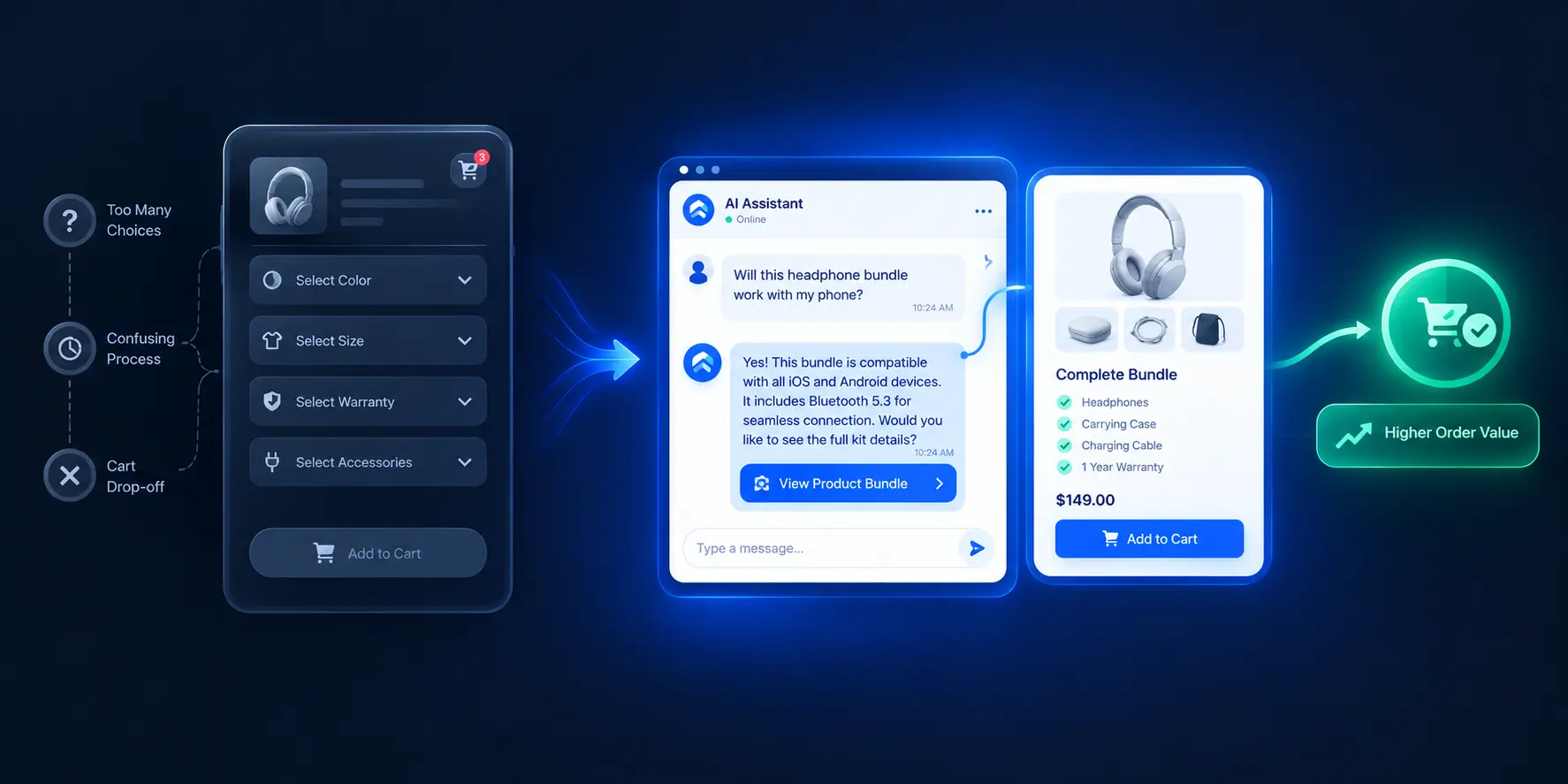
How D2C ecommerce brands use catalog-aware chat to guide shoppers through custom bundle and kit selection, eliminating choice paralysis and cart drop-off.
Beyond Dropdown Widgets: How D2C Brands Sell Complex Product Bundling in Chat
For direct-to-consumer brands, product bundles are the highest-leverage play in the AOV toolkit. A skincare routine bundled at 15% off. A camera kit with the right accessories pre-selected. A supplement stack tailored to a goal. Bundles move inventory, grow order value, and simplify purchase decisions — in theory.
In practice, many D2C stores find that their carefully constructed bundle offers underperform. Shoppers land on the bundle page, scroll through dropdown menus, and leave without adding anything to their cart. The bundle exists, the discount is clear, but the sale doesn't close.
The reason isn't the bundle. It's the interface.
The Bundle Paradox: Why Multi-Product Offers Fail on Mobile Screens
Variant Choice Paralysis: How Multi-Step Dropdowns Overwhelm Shoppers
Static bundle builders ask shoppers to make several decisions simultaneously through independent dropdown selectors: pick a size, select a shade, choose a variant, confirm a quantity. Each additional selection step multiplies decision fatigue. On mobile — where most D2C traffic lands — the dropdown format compresses complex decisions into small touch targets that shoppers fumble through or abandon entirely.
This pattern is especially damaging for product categories where the purchase decision carries real uncertainty:
- Skincare and beauty: Is this serum compatible with my skin type? Do these shades work together?
- Electronics and camera gear: Is this battery compatible with my body model? Does this lens mount work with my camera?
- Fitness and supplement bundles: Can I combine these? Is this stack right for my goal?
"Can I swap the cleanser for the sensitive skin version in this routine set?" The shopper asking this in your WhatsApp DMs isn't getting an answer from a Liquid dropdown.
The Silent Abandonment: Why Hesitant Browsers Bounce Instead of Building a Cart
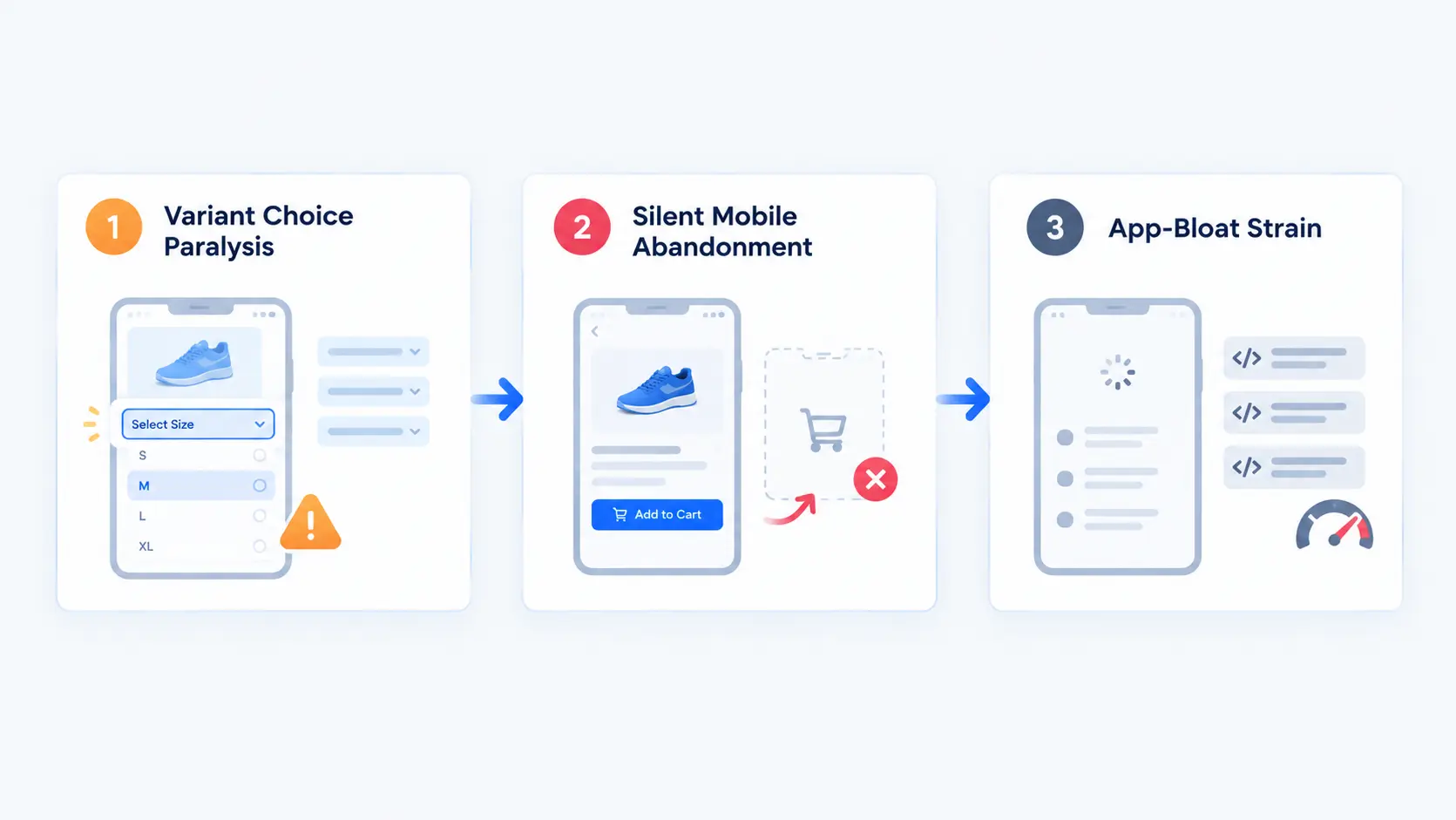
Bundle pages have the highest abandonment rates of any product category because they're built for configurators, not consultative sales. When a shopper can't quickly determine whether Product A pairs with Product B, or whether the bundle works for their skin type or gear setup, they don't dig deeper — they leave. There's no visible signal. No complaint form. Just a session that ends.
The loss compounds because bundle intent is often the highest-AOV scenario on your entire store. Losing a bundle sale means losing revenue on multiple SKUs simultaneously, and the customer who came back to ask may simply not return at all.
The App-Bloat Strain: Heavy On-Page Scripts vs. Mobile Site Performance
Adding a bundle app to a Shopify theme means injecting JavaScript widgets directly into your product templates. These scripts add page load weight, conflict with theme updates, and — from the merchant's side — represent recurring SaaS fees for a static configuration tool that can't answer a single customer question. Operators in ecommerce communities consistently flag this tradeoff as a source of ongoing frustration.
For stores already managing a lean app stack, each additional bundle, upsell, or cross-sell app represents a compounding maintenance burden. The widget renders. The bundle exists. And the sales question remains unanswered.
Why Static Bundle Widgets Break Down in Conversational Commerce
Unanswered Fit and Compatibility Questions (Why Static Dropdowns Can't Advise)
The core problem is structural: bundles are consultative purchases. A shopper considering a skincare routine needs to know whether the morning cleanser works with the retinol night serum. A camera buyer wants confidence that the free battery is compatible with their body model. These aren't configuration questions — they're advisory questions. Static widgets answer none of them.
Disconnected Support Channels: The Friction of Inquiring on WhatsApp or Instagram
When a shopper can't get an answer on the product page, they move to messaging channels: WhatsApp Business, Instagram DMs, Facebook Messenger, live chat. But most stores treat these channels as customer support escalation points rather than sales surfaces. The shopper asks a pre-purchase bundle question expecting a recommendation. Instead, they receive a generic "Let me check with the team" or a delayed reply. By the time a human agent answers, the purchase intent has cooled.
This is particularly costly for brands that run their primary customer acquisition through WhatsApp and Instagram, where the inbound channel itself is a question — and the answer needs to be instant.
The Disconnect Between Product Catalog Context and Messaging Inboxes
Even when a support agent is available, they often lack catalog context in the moment. They can't see live variant stock, can't pull up the latest bundle pricing rules, and can't recommend an alternative shade when the requested one is out of stock. The result is a back-and-forth conversation that requires multiple message exchanges to convey what a correctly configured bundle could have completed in one guided interaction.
On the shopper side, this reads as friction: ask a question on WhatsApp, wait, get a partial answer, ask a follow-up, wait again. Each pause is an abandonment opportunity. On the store side, it's the same cost reality as hiring additional support headcount without resolving the underlying context gap.
The Conversational Bundling Framework: From Dropdown Widgets to Consultative Sales
The alternative to static bundle pages is conversational bundling: using a catalog-aware AI to guide shoppers through bundle selection as a dialogue, not a dropdown.
Step 1: Map your high-value kits, routines, and compatibility rules
Step 2: Connect catalog attributes and stock data to your chat platform
Step 3: Deploy context-aware recommendations that respond to shopper input
Step 4: Route high-touch or custom bundle requests to a live agent
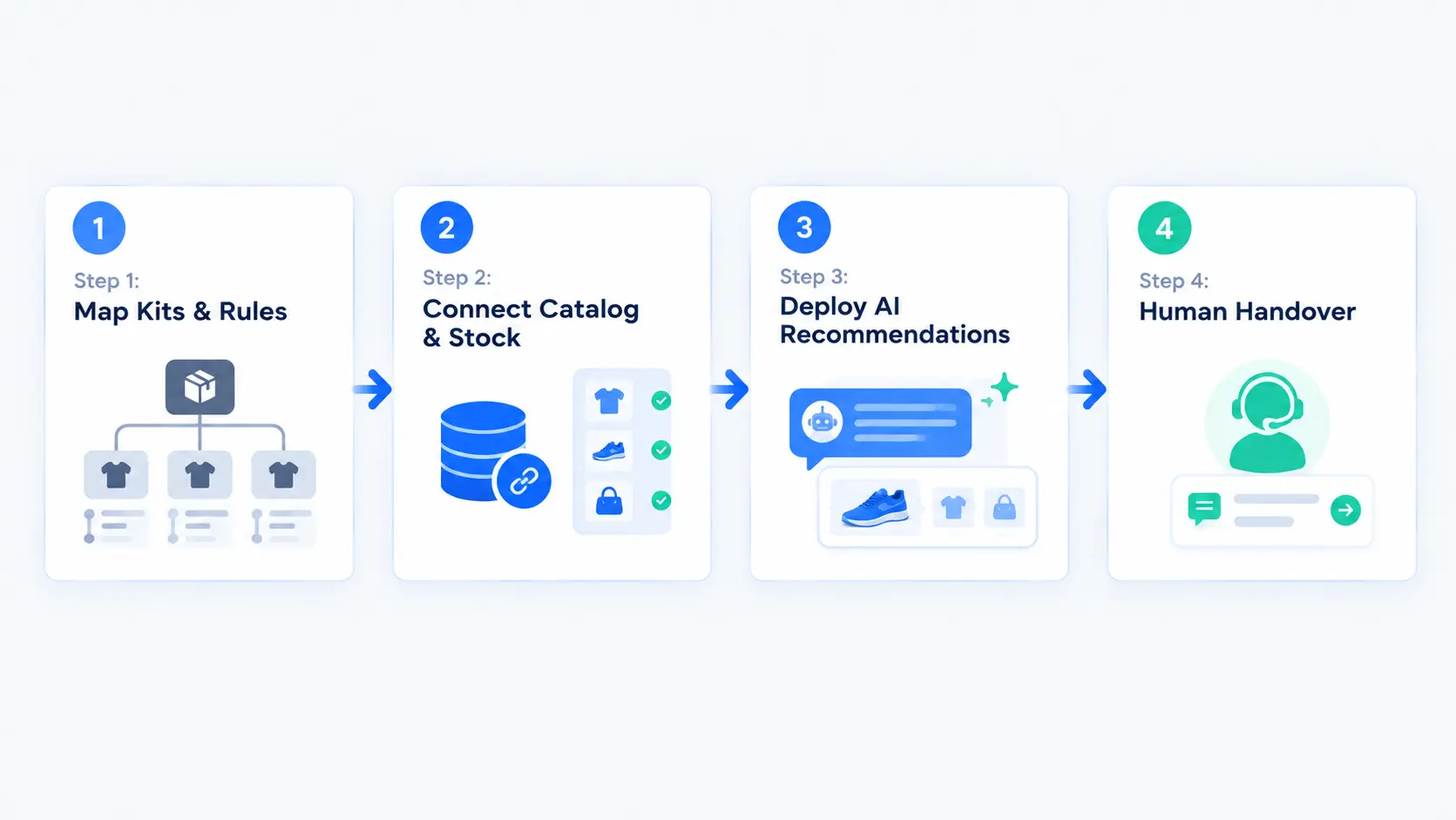
Step 1: Map Your High-Value Kits, Routines, and Product Compatibility Rules
Before deploying anything, audit your bundle catalog. For each bundle or kit, document:
- Which products must be bundled and which are swappable
- Compatibility constraints (skin type, equipment compatibility, size pairing rules)
- Frequently asked questions from previous customers
- The "if they ask X, recommend Y" decision paths your best sales associate uses
This becomes the knowledge base your conversational AI draws from. The more thoroughly your bundle rules are documented, the more accurately the AI can navigate the permutations a shopper will probe.
Step 2: Connect Store Catalog Attributes and Stock Data to Your Chat Platform
Bundle recommendations fail when the assistant suggests a variant that's out of stock or a combination that violates the bundle's own rules. Connecting your product catalog — including titles, variants, attributes, and stock status — ensures the AI only recommends combinations that actually exist and are currently available.
This catalog grounding is what separates conversational bundling from a generic FAQ bot: the AI isn't just answering from a static document; it's reasoning against your real inventory and product relationships.
Step 3: Deploy Contextual AI Recommendations to Guide Custom Variant Selection
Once your catalog data and bundle rules are ingested, the AI can answer the questions shoppers actually ask:
For example (fictional illustrative scenario):
Customer: "I have combination skin — will the morning moisturizer work with the vitamin C serum in the morning kit?"
AI assistant: "Both products are in the Morning Glow Kit. The morning moisturizer is compatible and can be layered after the vitamin C serum. If you prefer a lighter texture for combination skin, the gel variant of the moisturizer is also available in the kit. Want me to look up the full routine order?"
This is consultative selling — delivered at DM speed.
Step 4: Establish Unified Inbox Routing and Human Handover for High-Touch Custom Kits
For customers requesting something outside the standard bundle configuration — bulk corporate orders, custom color runs, or adjustments to kit composition — the AI hands the conversation directly to a human agent in a unified inbox. The agent sees the full conversation history, the shopper's stated preferences, and the current catalog state, so they can pick up without asking the customer to repeat themselves.
What to Look for in a Conversational Bundling Platform
Not all chat platforms support catalog-aware recommendation. When evaluating tools to power conversational bundling, look for:
| Capability | Why It Matters | Merchant Impact | |---|---|---| | Catalog Context Ingestion | AI reads live product attributes, variants, and stock levels | Recommendations reflect actual availability — no "backorder surprises" | | Multi-Channel Coverage | Bundle conversations happen on Website Chat, WhatsApp, Instagram DMs, and Facebook Messenger | One thread, one answer, regardless of channel | | Recommendation + Upsell Engine | Suggests complementary products and upgraded kits based on customer query | Passive browsing converts to structured bundle recommendations | | Unified Inbox + Human Handover | Seamless escalation when a shopper needs custom terms or complex advice | No dropped context between AI and human agents |
Conclusion & Operational Takeaway
Bundles fail not because the offer is wrong, but because the presentation format doesn't match the decision process. Shoppers assembling a skincare routine, configuring a camera kit, or selecting a supplement stack need guidance, not dropdowns.
Conversational AI trained on your product catalog closes the gap: it answers the question the shopper is actually asking, recommends the right combination from your live stock, and escalates to a human when the request moves beyond standard bundles. The result is fewer abandoned sessions, more completed high-AOV orders, and a storefront that works on every channel your customers prefer.
For D2C brands running high-velocity bundles as a primary revenue strategy, the shift from static widgets to conversational guidance isn't a UX upgrade — it's a revenue-recovery mechanism. Every bundle page that fails on mobile is an opportunity that could have been recovered in a chat window.
Ready to Eliminate Bundle Choice Paralysis?
Discover UpsellDesk — catalog-aware AI that guides custom bundle selection across Website Chat, WhatsApp, Instagram DMs, and Facebook Messenger, with seamless human handover when a conversation needs it.
Ready to get started?
Start using UpsellDesk today and transform your customer conversations.
Written by
UpsellDesk Team · Content Strategist at UpsellDesk
Related Articles
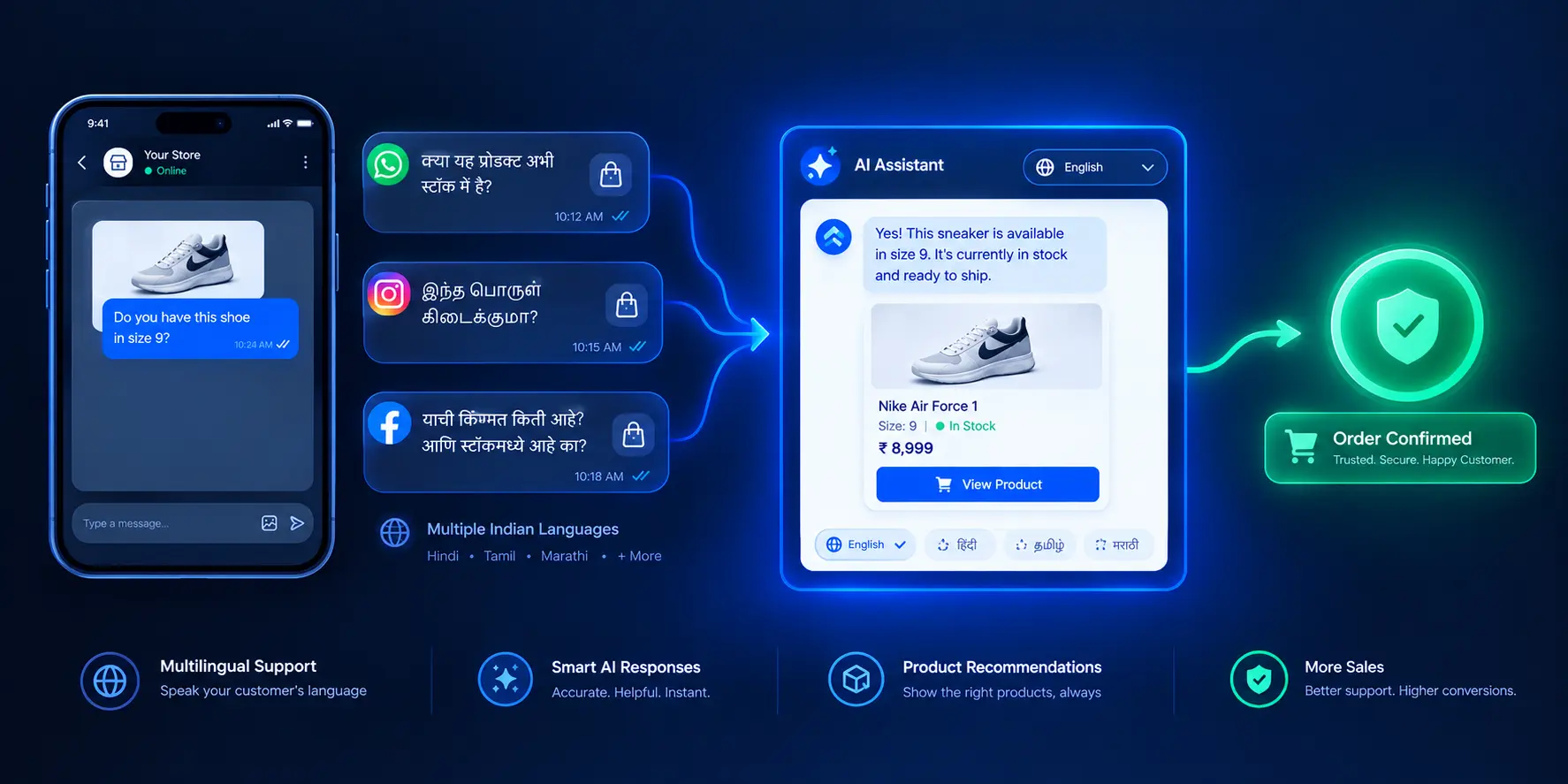
Selling in Tier-2 India: Handle Regional Language Inquiries with AI
Learn how Indian D2C brands answer Tier-2/3 shoppers in 22 regional languages using catalog-aware AI support across WhatsApp, Instagram, and website chat.
Ending "Price Kya Hai?" Chaos: Instagram Sellers Automate DM Sales
Learn how Indian Instagram sellers automate "Price?" comments into instant DM conversations with catalog details, turning social engagement into sales.
Stop Pre-Order Chargebacks: Automate Backorder Support
How D2C brands automate pre-order and backorder inquiries across WhatsApp, Instagram, and web chat to prevent chargebacks and cancellations.